
|
Stuck in last place
This article hasn't been able to keep up and may now include information that is no longer correct, you can help Xbox Wiki by bringing it up to speed and updating any old information. |


Xbox network (previously known as Xbox Live) is an online multiplayer gaming and digital media delivery service created and operated by Microsoft. It was first made available for the original Xbox on November 15, 2002.[2][3] An updated version of the service was made available for the Xbox 360 upon the system's launch in November 2005, and a further enhanced version was released in 2013 with the Xbox One.[Citation needed] This same version is also used with the Xbox Series X and Series S and, in addition to a Microsoft account, is the account for the Xbox ecosystem; accounts can store games and other content.
The service was extended in 2007 on the Windows platform, named Games for Windows – Live, now defunct, which made most aspects of the system available on Windows computers. The Microsoft Store and the Xbox app are now used to cross over the Xbox ecosystem into PC gaming, in addition to handhelds and mobile phones as part of the Xbox Play Anywhere initiative.[Citation needed] Microsoft's former mobile operating system, Windows Phone, included full Xbox Live functionality until it was discontinued.[Citation needed] The service shut down for the original Xbox on April 15, 2010, and original Xbox games are now only playable online through local area network (LAN) tunneling applications such as XLink Kai or replacement services such as Insignia.
Xbox network service is available as both a free and subscription-based service, known just as Xbox network and Xbox Live Gold, respectively, with most features such as online gaming restricted to the Gold service. Microsoft rebranded Xbox Live as "Xbox network" in March 2021 to encompass all services related to Xbox and differentiate the Xbox Live Gold subscription service from these other services.
On September 14, 2023, Xbox Live Gold was superseded by Xbox Game Pass Core, which gives players access to multiplayer capabilities, a select collection of over 25 games to play, and exclusive member deals for a subscription fee of US$9.99 per month or US$59.99 per year.[4]
History
Launch with the original Xbox
As Microsoft developed the original Xbox, online gaming was designated as one of the key pillars for the greater Xbox strategy. Sega had attempted to capitalize on the ever-growing online gaming scene when it launched the Dreamcast video game console in 1999, including online support as standard, with the SegaNet service in North America and Dreamarena in Europe. Nevertheless, due to a lack of widespread broadband adoption at the time, the Dreamcast shipped with only a dial-up modem, while a later-released broadband adapter was neither widely supported nor widely available. Downloadable content was available, though limited in size due to the narrowband connection and the size limitations of a memory card. The PlayStation 2 did not initially ship with built-in networking capabilities.
Microsoft, however, hoped that the Xbox would succeed where the Dreamcast had failed. The company determined that intense online gaming required the throughput of a broadband connection and the storage space of a hard disk drive, and thus these features would be vital to the new platform. This would allow not only for significant downloadable content, such as new levels, maps, weapons, challenges and characters, to be downloaded quickly and stored, but also would make it possible to standardize bandwidth-intensive features such as voice communication. Steve Ballmer and Bill Gates both had a vision of making premium download content and add-ons that would attract many new customers. Based on this reasoning, the console included a standard Ethernet port (10/100) to provide connectivity to common broadband networks. However, it did not include a modem or any dial-up support, and its online service was designed to support broadband users only. Critics scoffed at it, citing poor broadband adoption at the turn of the century.
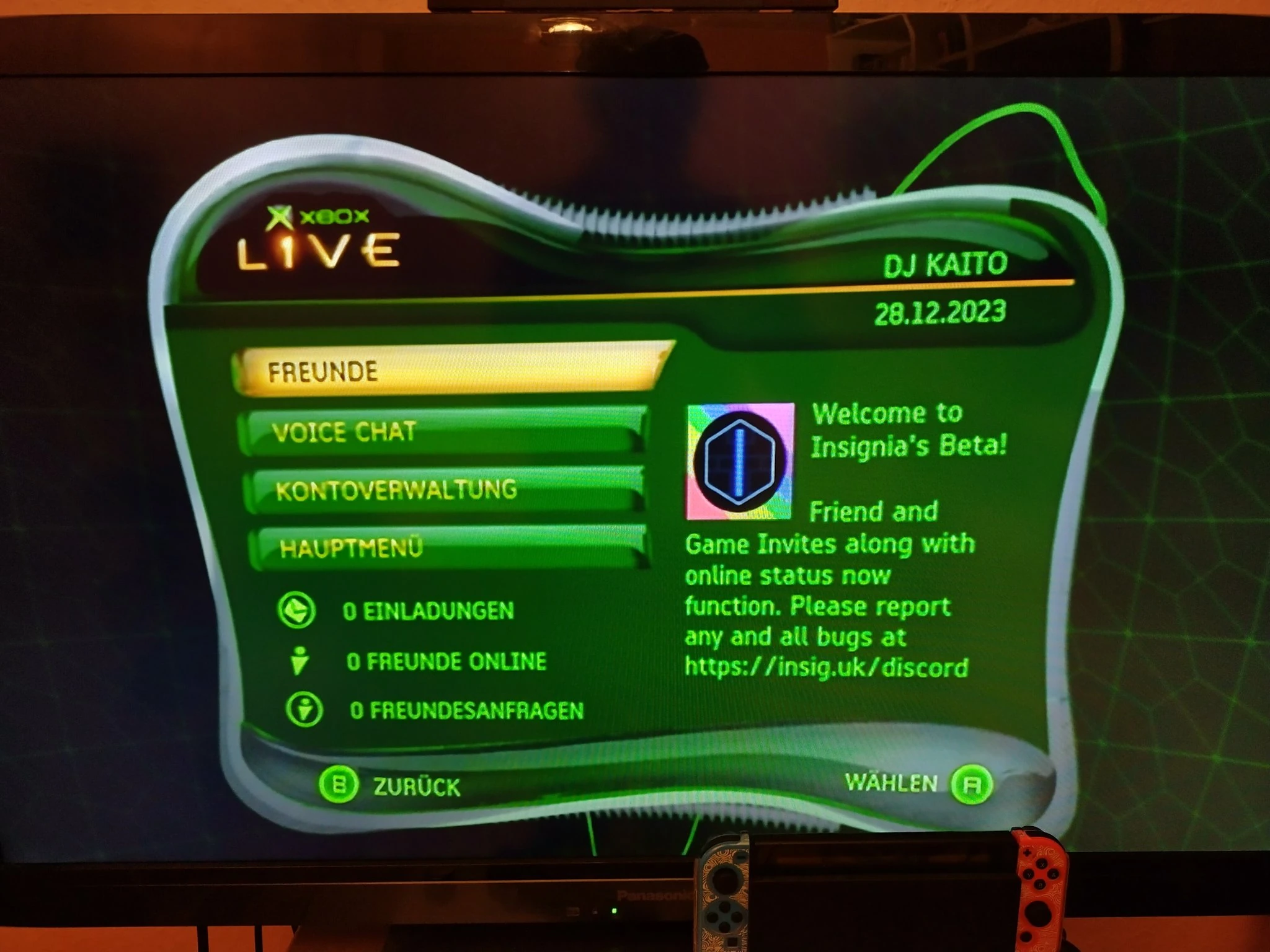

Xbox Live Dashboard on the original Xbox (connected via Insignia)
When the Xbox launched on November 15, 2001, the as-yet unnamed online service was destined for a Summer 2002 deployment. Xbox Live was finally given a name at E3 2002 when the service was unveiled in its entirety. Sound-dampened booths and broadband-connected Xbox consoles—featuring an early version of Unreal Championship—demonstrated the service on the show floor. The Epic title was one of the flagship titles for the service, which was slated for a debut on November 15, 2002, marking the anniversary of the Xbox launch. Microsoft announced that 50 Xbox Live titles would be available by the end of 2003. Utilizing the required broadband bandwidth, Xbox Live featured a unified gaming "Friends List", as well as a single identity across all titles (regardless of the publisher), and standardized voice chat with a headset and communication, a feature that was still in its infancy. The Xbox Live Dashbord as known today, was introduced with the launch of "Xbox Live 2.0", named Xbox Live Now in Septemeber 2003.[5]
Leading up to the launch, Microsoft enlisted several waves of beta testers to improve the service and receive feature feedback. The first wave of beta testers was given Revolt! (which was never released officially) and NFL Fever to beta test. Once beta testing concluded, Microsoft sent these beta testers a translucent orange memory card, a headset carrying case, and a beta tester T-shirt with the slogan "I have great hands". When the service debuted, it lacked much of the functionality that later titles included, but Xbox Live grew and evolved on the Xbox and many aspects of the service were included with the Xbox 360 console out of the box, rather than through a later update. Microsoft's 5000th patent was Live-related and gave Xbox 360 users access to watch other gamers compete against each other over Xbox Live.
The packaging for playable Xbox Live titles on the original Xbox console featured the trademark gold bar underneath the Xbox header. Tom Clancy's Splinter Cell and Brute Force sported a Live "bubble" design, as they only featured downloadable content. It was changed later, wherein all Xbox Live titles included the universal gold Live bar. By the time of the Xbox 360, all titles were required to provide at least a limited form of Xbox Live "awareness". By the end of 2003, Xbox Live reached 500 thousand users. In the United States, 25% of all consoles by that were registered.[6] In July 2004, Xbox Live had reached 1 million online users, and only a year later, that figure had doubled to 2 million online users.
Subsequent growth
On November 15, 2007, Microsoft celebrated Xbox Live's 5th anniversary by offering its then over 8 million subscribers the title Carcassonne free of charge and awarding gamers who had subscribed to Live since its inception 500 free Microsoft Points. Due to intermittent service interruptions during late December 2007 and early January 2008, Microsoft promised to offer a free Xbox Live Arcade game to all Xbox Live users as compensation, in an open letter to all Xbox Live members from Marc Whitten, Xbox LIVE General Manager. Increased demand from Xbox 360 purchasers (the largest number of new user sign-ups in the history of Xbox Live) was given as the reason for the downtime. On January 18, 2008, Microsoft announced Undertow would be offered free to both Gold and Free members for the week starting January 23 through January 27 as compensation.
On November 12, 2009, Dennis Durkin, COO of Microsoft's interactive entertainment business, announced that on November 10, 2009, the release of Call of Duty: Modern Warfare 2 marked the busiest day ever on Xbox Live, with over two million active users simultaneously.
On February 5, 2010, Marc Whitten announced that Xbox Live had reached 23 million members. On the same day, Larry Hryb, Xbox Live's Major Nelson, announced on his blog that Xbox Live support for the original Xbox would be discontinued on April 15, 2010, including online play through backwards compatibility on the Xbox 360 and all downloadable content for original Xbox games. After that, original Xbox games could only be played over tunnel software like XLink Kai. In 2022, the service Insignia launched to recreate the original Xbox Live.
In August 2010, Microsoft announced an increase to the cost of Xbox Live Gold in several countries by 20%, for the first time since its inception. The basic service was also renamed. Prior to October 2010, the free service was known as Xbox Live Silver.
It was announced on June 10, 2011, that the service was going to be fully integrated into Microsoft's Windows 8.
In October 2011, Microsoft announced live streaming cable television with various providers.
In February 2013, Yusuf Mehdi, corporate vice president of Microsoft's Interactive Entertainment Business, shared that Xbox LIVE members now number 46 million, up 15 percent from a year ago, during the Dive into Media conference in Southern California.
In June 2014, Microsoft retracted the Xbox Live Gold requirements to download streaming media apps (including Netflix, Hulu, YouTube, Internet Explorer, Skype, and others), though various rental or subscription fees may still apply.
On December 25, 2014, both PlayStation Network and Xbox Live suffered network disruption after a denial-of-service attack. Functionality was restored on December 28, with some users experiencing difficulties in the days that followed. A group called "The Phantom Squad" has threatened to disrupt the Xbox Live network through a denial-of-service attack on December 25, 2015
In 2019, the Official Xbox Magazine revealed that Xbox Live would be made cross platform, and will serve Android, iOS, and Nintendo Switch.
Microsoft added Xbox Live Gold to its Xbox Game Pass program as part of a new Xbox Game Pass Ultimate subscription tier in April 2019.
Rebranding
On March 22, 2021, Xbox Live was rebranded to Xbox network to distinguish the underlying service from Xbox Live Gold memberships. This change also included a multiplayer free-to-play game no longer requiring an Xbox Live Gold membership.
On September 14, 2023, Xbox Live Gold was discontinued and replaced by Xbox Game Pass Core, which carries most of the same benefits as Xbox Live Gold, while replacing the "Games with Gold" program with access to a limited rotation of Game Pass titles.
Availability
The Xbox network is available in forty-one countries. Availability can also be checked here.
|
|
Users from other countries are not officially supported, although it is possible for them to access Xbox network if they provide an address located in a country where Xbox network is officially available. The country selected during account creation affects the payment options, content, and services available to the user.[Citation needed] Previously, users were unable to change their account region, but in October 2012, Microsoft introduced an account migration tool as a pilot project, which allows users to change their region and maintain their Xbox network profile. Subscriptions, such as that for Xbox Music, cannot be transferred with this method.[7]
On March 5, 2022, the Xbox team announced that it had suspended all Xbox network services in Russia in response to the 2022 Russian invasion of Ukraine.[8]
User information
Gamertag
A Gamertag is a universal name for a player's username on the Xbox Network. A Gamertag is a unique identifier that can include numbers, letters, and spaces. Gamertags can be changed using an Xbox One or Xbox 360 console (first time is free, all other changes afterwards are charged).
Gamertags also contain avatar images, or gamerpics, sometimes associated with certain games or game characters. On Xbox 360 individual gamerpics are available, but they are usually bundled into packs. It is also possible to take "Public" pictures (which are shown to all who view a profile, unless the user has a different "personal" picture set), which can be taken of avatars while using the avatar editor.
Gamerscore
The Gamerscore (G) is an achievements point accumulation system that reflects the number of achievements accumulated by a user on Xbox through the displaying of the number of points accumulated. Gamerscore can be awarded for the completion of game-specific challenges, such as beating a level or amassing a specified number of wins against players.
Initially, retail Xbox 360 games offered up to 1,000 G spread over a variable number of achievements, while each Xbox Live Arcade title contained 12 achievements totaling 200 G. On February 1, 2007, Microsoft announced via their Gamerscore Blog some new policies that developers must follow relating to Gamerscore and achievements in future releases:
- All regular disc-based games must have 1,000 G in the base game; the title can ship with fewer than 1,000 points, but anything added later must be free.
- Game developers have the option of adding up to 250 points via DLC content every quarter after the first year of release, for a total of 1,750 G.
- Xbox Live Arcade title allowed players to obtain Gamerscore, initially up to 200 with additional points up to 50 G via DLC (for a total of 250 points). Some XBLA games now contain up to 400 Gamerscore without DLC.
On March 25, 2008, Microsoft cracked down on "Gamerscore cheaters" (those who used external tools to artificially inflate their Gamerscore), and reduced their scores to zero without an option to recover the scores that had been "earned". The cheating players were also branded as such in their Gamertags.
On March 13, 2014, Ray Cox IV (known as "Stallion83") became the first player in history to reach 1 million gamerscore.
Many websites have been created to provide gamers with tips and tricks for getting Gamerscore. Some sites are solely devoted to these achievement guides, whereas some blogs provide gaming guides in addition to their other content.
Gamercard
The Gamercard is an information panel used to summarize a user's profile on the Xbox network. The pieces of information on a Gamecard include:
- Gamertag
- Gamer picture (Avatar)
- Reputation (only shown on Xbox One and Xbox Series X|S if the viewed player is constantly violating the Community Standards)
- Tenure (the amount of time a player has been subscribed to Xbox Game Pass Core or Ultimate)
- Gamerscore
- Gamer Zone (Xbox 360 only)
- Recently played games
A player's Gamercard can be viewed via the guide, the Xbox ap, or online through Xbox.com.
On Xbox 360, there were four Gamer Zones: Recreation is for casual gamers, Family is for family-friendly gamers (without profanity, etc.), Pro is for competitive gamers who enjoy a challenge, and Underground is for no-holds-barred gaming where anything goes (as long as it does not violate the Xbox Live Terms of Use). However, in practice, these gamer zones were displayed only on the Gamercard of the player and did not tend to affect the gameplay experience or the matching of players in online games.
TrueSkill
TrueSkill is a ranking and matchmaking system first implemented as part of the Xbox 360's Live service. It uses a mathematical model of uncertainty to address weaknesses in existing ranking systems, such as Elo. For example, a new player joining million-player leagues can be ranked correctly in fewer than 20 games. It can predict the probability of each game outcome, which enhances competitive matchmaking, making it possible to assemble skill-balanced teams from a group of players with different abilities.
When matchmaking, the system attempts to match individuals based on their estimated skill level. If two individuals are competing head-to-head and have the same estimated skill level with low estimate uncertainty, they should each have roughly a 50% chance of winning a match. In this way, the system attempts to make every match as competitive as possible.
In order to prevent abuse of the system, the majority of ranked games have relatively limited options for matchmaking. By design, players cannot easily play with their friends in ranked games. However, these countermeasures have failed due to techniques such as alternate account(s) and system flaws, where each system has its own individual TrueSkill rating. To provide less competitive games, the system supports unranked Player Matches, which allow individuals of any skill level to be paired (often including "guests" on an account). Such matches do not contribute to the TrueSkill rating.
Microsoft Store
The Microsoft Store is the current digital marketplace for the Xbox ecosystem, starting in 2017 for the Xbox One. It is available on consoles and on Xbox's website, offering games from across all of Xbox's generations, in addition to movies, television shows, and multiple apps available as streaming services for music or television.
Xbox Play Anywhere
Originally called Live Anywhere, Play Anywhere is a cross-platform service allowing owners of Xbox and Windows games the ability to use said games on either platform. Under the scheme, supported games purchased digitally on Microsoft Store for Xbox One can also be downloaded on a Windows 10 PC (running Windows 10 Anniversary Update or later) through Microsoft Store using the same Microsoft account at no additional charge, and vice versa. The scheme also promotes the ability to synchronize save data, achievements, and downloadable content between Windows 10 and Xbox One versions of a game.
Microsoft announced in March 2019 that it would be providing Xbox Live SDKs for iOS and Android mobile devices, allowing developers on those platforms to integrate most services of the Xbox network into their applications and games. Microsoft also stated that they were looking to bring this functionality to the Nintendo Switch, anticipating this to be a post-launch feature for the Switch port of Cuphead.
Security
Microsoft implements several security measures on its Xbox Network service. One of these takes the form of a proactive security check that ensures only unmodified machines can access their service. On May 17, 2007, Microsoft banned consoles with modified firmware from the Xbox Network. According to Microsoft, consoles with firmware of unknown origin, quality, or intent were permanently banned from the Xbox Network. A Microsoft representative indicated that the action was taken to assure "the integrity of the service and protect our partners and users."
It has been discovered that pretexting has been used to impersonate an Xbox Network user for sabotage. Microsoft has implemented greater security to decrease the service's susceptibility to social engineering.
In early November 2009, Microsoft banned approximately 1 million consoles with modified firmware from the Xbox Network.[9]
In October 2011, users of Xbox Network reported having unauthorized access to their Xbox network accounts, with Microsoft points subsequently being used and/or bought to purchase various in-game items for FIFA 12. Microsoft responded to such incidents by restricting access to the account for 25 days while the fraud team investigates. Both Electronic Arts and Microsoft have denied any security issues.
On December 25, 2014, both PlayStation Network and Xbox network suffered network disruptions after a denial-of-service attack. Functionality was restored on December 28, with some users experiencing difficulties in the days that followed.
Gallery


See also
References
- ↑ Ivan, Tom (January 24, 2023). "Microsoft says Xbox monthly active users hit a record 120 million". Video Games Chronicle.
- ↑ Varanini, Giancarlo (November 15, 2002). "Xbox Live launches". GameSpot.
- ↑ "Xbox Live Arrives in Stores, Sparking the Next Revolution in Video Games". Microsoft News. Microsoft (November 15, 2002).
- ↑ West, Jerret (July 17, 2023). "Introducing Xbox Game Pass Core, Coming This September". Xbox Wire.
- ↑ GamePro Germany, 10/2003, P. 130
- ↑ GamePro Germany 1/2004, P.16
- ↑ Alexa Ray Corriea (January 16, 2013). "Xbox Live regional account migration tool is now live". Polygon. Archived from the original on January 19, 2013.
- ↑ Callum Bains, Vic Hood (March 4, 2022). "Microsoft halts Xbox sales in Russia following Ukraine's call to 'block' accounts". TechRadar.
- ↑ Terdiman, Daniel (November 11, 2009). "Report: Microsoft bans 1 million Xbox Live players". CNET News. Archived from the original on March 8, 2013.